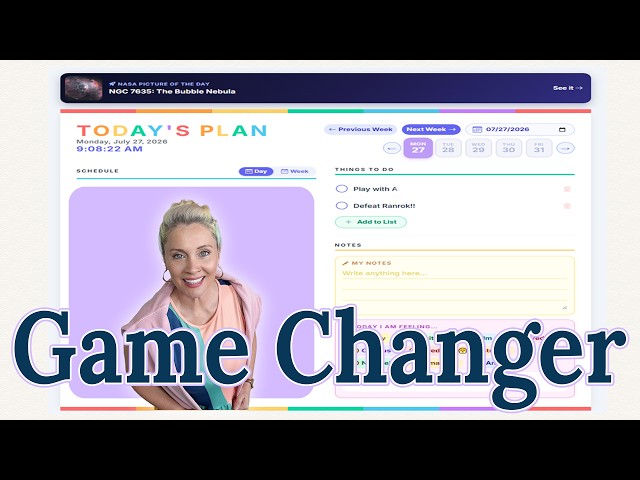
Building Our Homeschool Student Planners with Homeschool Gradebook
For almost ten years, our homeschool has been built around paper.
Paper planners. Printed curriculum. Checklists. Sticky notes. Calendars taped to the refrigerator. Random notebooks with ideas scribbled in the margins.
It has worked.
But our homeschool isn’t the same homeschool it was ten years ago.
This year I’ll be homeschooling a ninth grader and a fifth grader. High school transcripts are officially part of our reality, my kids are asking for more independence, and I need a system that can grow with us instead of creating more work.
So this year, we’re trying something completely different.
We’re building digital student planners using Homeschool Gradebook from HomeschoolGrades.com.
No, this post isn’t sponsored.
Yes, I’ve worked with them before.
But this decision had nothing to do with sponsorship. It had everything to do with timing. As I started putting together our school year, this ended up checking a surprising number of boxes that I was already looking for.

Be sure to subscribe to our monthly newsletter to be an insider and to follow along with our days over on Instagram @makingeverydaymagic.
Why We Decided to Switch to Digital Student Planners
The funny thing is…this wasn’t even my idea.
It was my kids’.
As they’ve gotten older, they naturally want more ownership over their school day. They already do so much independently that handing them another paper planner honestly felt like moving backward.
Instead, I wanted something where they could:
- see their daily assignments
- check off completed work
- review vocabulary
- keep reading logs
- communicate with me
- track their progress
- begin managing their own responsibilities
without needing me to constantly remind them where everything is.
That doesn’t mean paper planners are wrong.
It just means our homeschool has reached a point where digital planning actually makes sense.
Planning the School Year Starts Months Before School
If you’ve watched my channel this summer, you know we’ve been building toward this moment for months.
We’ve selected curriculum.
We’ve planned biology.
We’ve mapped out French.
We’ve chosen our math.
We’ve organized Michael Clay Thompson Language Arts.
We’ve discussed high school credits and transcripts.
We’ve planned our calendar.
We’ve built flashcard lists.
We’ve figured out extracurricular activities.
By the time I sat down inside Homeschool Gradebook, I finally felt like I had enough pieces to build the actual framework for our school year.
That framework is what the student planners became.
What Is Homeschool Gradebook?
Homeschool Gradebook (available through HomeschoolGrades.com) is an all-in-one homeschool record-keeping and planning platform.
Depending on which version you choose, it can handle things like:
- lesson planning
- grade tracking
- attendance
- GPA calculations
- transcript generation
- report cards
- student journals
- reading logs
- flashcards
- typing practice
- document storage
- state compliance tools
- calendars
- parent and student dashboards
One thing I genuinely appreciated is that there are free options.
Whether you’re looking at Homeschool Light or Homeschool Grades, you don’t have to jump into a paid subscription just to see if the platform works for your family.
I always appreciate when homeschool companies let families actually use a product before asking them to commit financially.
What I Actually Set Up
Instead of entering every single lesson from every curriculum, I focused on building a system that would actually support our daily homeschool.
For both kids I created:
- personalized student dashboards
- weekly schedules
- subject organization
- flashcard sets
- chores
- grade tracking
- assignments
- messaging
- achievements
For my high schooler, transcript planning was one of the biggest reasons I wanted everything centralized.
Keeping grades, assignments, credits, and documentation together makes me feel much more confident about maintaining accurate records throughout high school.

My Favorite Features So Far
There were a handful of features that immediately stood out.
Flashcard Imports
This one honestly surprised me.
I had already built vocabulary lists for our Michael Clay Thompson curriculum, including Caesar’s English.
Instead of manually recreating every flashcard, I imported my spreadsheet directly into the platform.
That alone saved me a tremendous amount of time.
Student Dashboards
Each child has their own login.
They aren’t looking at my planning screen.
They’re looking at their planner.
Their assignments.
Their chores.
Their flashcards.
Their reading log.
Their upcoming work.
That separation makes it feel much more like their own workspace instead of simply borrowing mine.
Reading Logs
My kids love tracking what they read, and having the reading log integrated directly into the planner means it’s much more likely to stay updated throughout the year.
Transcript Support
This is probably the biggest one for me.
High school changes homeschooling.
Not because learning suddenly becomes different, but because documentation becomes more important.
Having transcript tools built into the same platform where we’re already tracking assignments and grades makes a lot of sense for this stage of our homeschool.
Customization
One tiny thing that I absolutely appreciated was being able to customize the dashboard.
For example, there was originally a Bible verse displayed on the homepage.
Because we’re a secular homeschool, I was able to switch that out for NASA’s Astronomy Picture of the Day instead.
It seems like a small feature, but I genuinely appreciate when companies recognize that homeschoolers aren’t all looking for the exact same experience.
That flexibility matters to me.
Is It Perfect?
Probably not.
Honestly, I expect setting everything up to be the hardest part.
That’s true of almost every homeschool organizational system I’ve ever used.
The beginning always requires the most work.
But once the structure is built, I expect maintaining it throughout the year to be much easier than trying to manage half a dozen separate tools.

Will We Keep Using It?
We’ll see.
One thing I always say on my channel is that I am not attached to methods.
I’m attached to what works.
If this system helps my kids become more independent…
If it simplifies transcript management…
If it reduces the daily mental load…
Then we’ll absolutely keep using it.
If it doesn’t?
We’ll pivot.
Homeschooling has always been about building a life that works for your family—not forcing your family to fit someone else’s system.
Right now, Homeschool Gradebook feels like the right fit for this season of our homeschool, and I’m genuinely excited to see how it works once the school year begins.
I’ll definitely be sharing an update after we’ve actually lived with it for a while, because setting up a planning system is one thing.
Using it every day is what really matters.